


Another exclusive interview from IMGlobalWealth.com
In a second* exclusive interview with IMGW.news, Premier Mark Brantley argues that the next generation of investment migration will be smaller, more demanding and much more closely connected to where wealthy families actually live, invest and structure their affairs. For Nevis, that means bringing citizenship, residence, financial services and lifestyle into a single proposition.
For more than four decades, St Kitts and Nevis has occupied an unusual position in global investment migration. It pioneered citizenship by investment in 1984. Now, Premier of Nevis Mark Brantley believes the model is entering another transformation.
His prediction is striking: by 2035, investment migration may involve fewer applicants paying more, undergoing tougher scrutiny and establishing a much stronger connection with their adopted country.
But before looking forward, Brantley argues that the industry’s past deserves closer examination.
“There is a dividend that flows from geopolitical irrelevance.”
1. What did CBI actually build?
IMGW.news: For somebody living in Nevis who has never applied for a second passport, what has investment migration actually delivered?
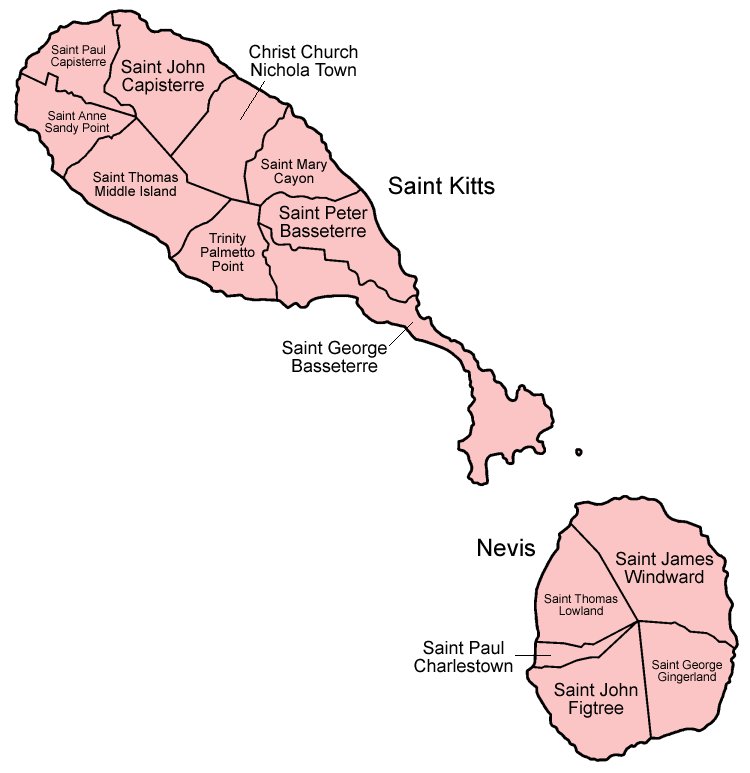
💬 Mark Brantley: In very small countries like ours, the tax base is naturally quite thin. Nevis has only about 13,500 people. Citizenship by investment allowed us to access a revenue stream without putting additional pressure on that domestic tax base.
Its impact goes far beyond government revenue.
Look at tourism. The Four Seasons in Nevis, the Park Hyatt and Marriott in St Kitts have all benefited in different ways from investment associated with citizenship. Those properties employ thousands of people and create economic activity around them, from farmers and fishermen supplying hotels to construction and other services.
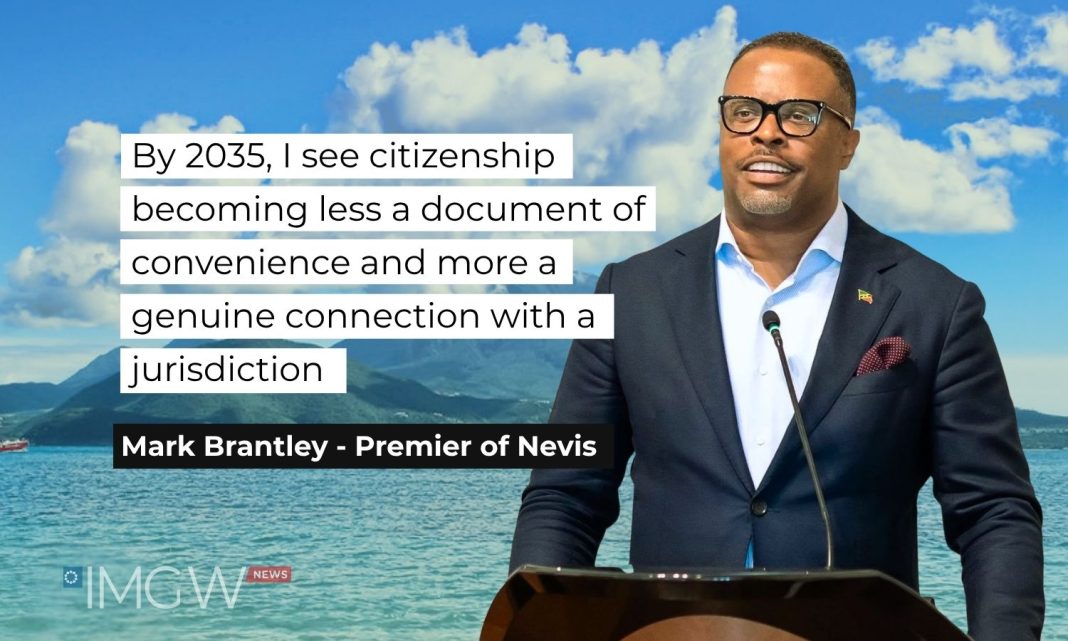
“By 2035, I see citizenship becoming less a document of convenience and more a genuine connection with a jurisdiction”
In Nevis, CBI funding also helped develop our water-taxi facility, which transformed travel between Nevis and St Kitts. We have invested in electricity, water distribution and storage, healthcare, education and social programmes.
Perhaps most importantly, additional revenues allowed us to strengthen safety nets for the elderly, poorer families and people requiring government assistance.
So the impact is not simply a passport being issued to somebody overseas. There is a cascading effect throughout the economy.

2. From owning the passport to knowing the country
IMGW.news: That distinction is important because Brantley believes the next phase of investment migration will require a much closer relationship between investor and jurisdiction. If an internationally mobile family considered Nevis today as a genuine second home rather than simply a source of citizenship, what would they find?
💬 Brantley: We offer a very particular lifestyle. Fresh air, fresh food, farm-to-table and sea-to-table dining, privacy and a slower pace of life.
But it also has to function as a real place in which people can live and work. We have excellent broadband connectivity, established professional services, democracy, an independent judiciary and the Privy Council in London as our final appellate court.
Nevis is not trying to become a mass destination. Nor are we trying to compete on ostentation. It is about quality rather than “bling”.
For wealthy families, that distinction may be becoming more important. Geographic diversification is increasingly being considered alongside asset diversification. A family may have investments across several markets yet remain overwhelmingly exposed to a single country for residence, citizenship and personal security.
Brantley describes the Caribbean’s relative distance from the world’s major geopolitical flashpoints as an increasingly valuable characteristic.
Nevis, he argues, is sufficiently connected to North and South America and Europe while remaining outside most major theatres of geopolitical confrontation.
3. Wealth management meets investment migration
IMGW.news: Perhaps the most significant development Brantley identifies is the convergence between two industries that Nevis has participated in for roughly four decades: investment migration and international financial services. Could Nevis evolve from being known principally as a citizenship jurisdiction into a broader wealth-management and family-office centre?
💬 Brantley: I think we have all the ingredients. We just need to bake the cake.
Historically, somebody might establish a trust or company here but never actually visit. Similarly, somebody might acquire citizenship without developing any real relationship with the island.
That is changing.
People are increasingly thinking simultaneously about asset protection, succession, residence, citizenship and where they actually want to spend their time.
“I think the numbers are going to be smaller, but the value is going to be greater.”
Someone can have a home here, conduct business internationally because the connectivity exists, and also use established professional structures within the jurisdiction.
One area we are looking at is the family-office phenomenon. We want to create incentives and easier pathways for people who wish to establish themselves here.
Brantley says the Nevis Investment Promotion Agency and other government initiatives are intended to reduce friction for investors and returning members of the diaspora.
Healthcare remains one practical consideration for families contemplating relocation. Brantley acknowledges the limitations inherent in a population of Nevis’s size, particularly for highly specialised medicine, while pointing to investment in diagnostic equipment and primary healthcare and established arrangements for medical evacuation to larger regional centres when specialist treatment is required.
4. A changing relationship with Europe
Brantley is less optimistic that repeated reform of Caribbean CBI programmes will restore the international environment that existed a decade ago.
The Caribbean, he argues, has repeatedly increased investment thresholds, strengthened due diligence and responded to demands from the US, UK and EU. The five Eastern Caribbean CBI jurisdictions are also moving towards greater regulatory alignment.
Yet political attitudes towards immigration and citizenship have changed in many developed economies.
“We have reformed and reformed, and then we have reformed those reforms,” he says.
His conclusion is not that traditional alliances should be abandoned. Rather, Caribbean governments should strengthen them while accepting that they cannot build their economic future around assumptions that those relationships will remain unchanged.
That means diversification, new partnerships and a more sophisticated proposition to international families.
5. What will investment migration look like in 2035?
It is here that Brantley makes perhaps his clearest prediction.
IMGW.news: St Kitts and Nevis created the modern CBI model. What does investment migration look like in 2035?
💬 Brantley: I think the numbers are going to be smaller, but the value is going to be greater.
The cost of entry will probably move upwards. Due diligence requirements will become more stringent. There will be greater international cooperation around security.
But I believe citizenship by investment will still be with us.

The biggest change, in my view, will be the nexus between the passport holder and the country.
Residence, second homes, property development, quality of life, safety, security and stability will increasingly become part of the programme.
By 2035, I see citizenship becoming less a document of convenience and more a genuine connection with a jurisdiction.

That may ultimately be the most consequential evolution of the industry St Kitts and Nevis helped create.
For decades, investment migration was largely about acquiring another passport. Its next chapter may instead be about acquiring another place: somewhere to live, invest, structure wealth and, when necessary, go.
As Brantley puts it, migration itself is hardly new. People have crossed borders in search of opportunity and security throughout human history. Technology has merely made the world smaller.
The question for investment migration is therefore unlikely to be whether mobility disappears.
It is what governments demand in return for it, and how much genuine connection investors are prepared to build with the countries whose citizenship they acquire.

