



An IMGlobalWealth.news Report
For the world’s wealthy, the ultimate luxury is increasingly measured not in property, yachts or private jets, but in additional years of healthy life. A booming industry is emerging to satisfy that ambition.
The global wellness economy reached a record US$6.8 trillion in 2024, growing 7.9% in a single year, according to the Global Wellness Institute (GWI). The organisation forecasts that spending will approach US$9.8 trillion by 2029, driven partly by rising demand for preventive healthcare, personalised medicine and longevity treatments
Among affluent consumers, the pursuit of longer, healthier lives is becoming an increasingly important consideration in how wealth is spent.

An earlier UBS survey, conducted in 2017–18 among more than 5,000 wealthy investors across ten markets, illustrated how strongly affluent individuals valued longevity. It found that 90% considered investing in their health more important than increasing their wealth, while 92% believed their financial resources enabled them to lead healthier lives.
Remarkably, investors with assets exceeding US$10 million spent four times as much annually on healthcare as less wealthy respondents. The wealthiest participants indicated they would surrender nearly half their fortunes in exchange for another decade of healthy life.

The financial industry is responding.
According to industry figures reported by The Washington Post, global investment in longevity companies reached US$8.49 billion in 2024, an increase of 220% over the previous year. Silicon Valley billionaires, including Jeff Bezos, have been associated with investments in experimental technologies seeking to address biological ageing.
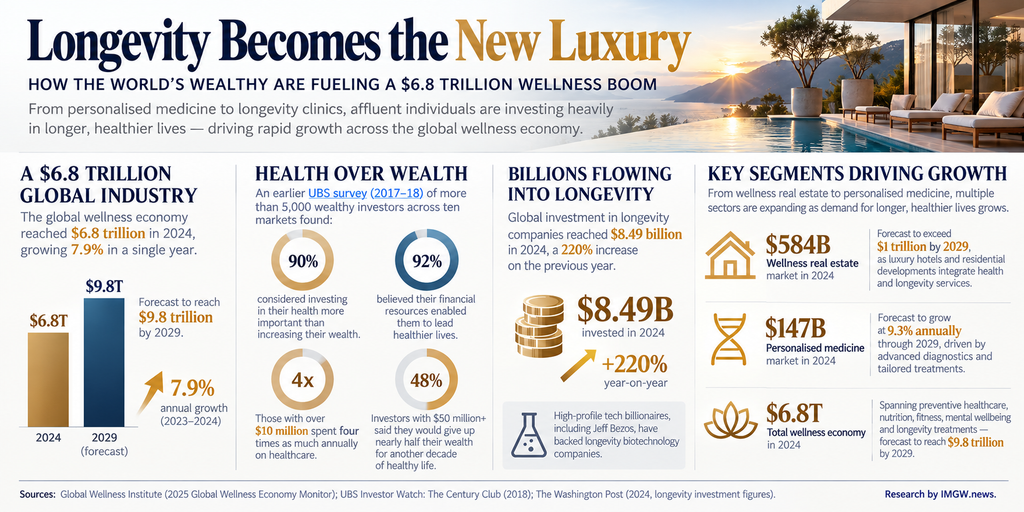
Meanwhile, the GWI estimates that wellness real estate, encompassing properties designed around health and wellbeing, reached US$584 billion in 2024 and could exceed US$1 trillion by 2029.
Luxury hotels, residential developments and specialist clinics are increasingly incorporating advanced diagnostics, personalised nutrition, recovery facilities and preventive healthcare services.

The geographical expansion is particularly evident in the Gulf and Asia, where high-end hospitality operators are integrating medical wellness services into their offerings.
Personalised medicine, already a US$147 billion market according to the GWI, is forecast to expand by 9.3% annually through 2029.
Yet the commercial enthusiasm comes with important qualifications. Many treatments marketed as anti-ageing interventions lack sufficiently robust clinical evidence demonstrating that they extend human lifespan.
The emerging divide is therefore not simply between those who can afford longevity treatments and those who cannot, but between commercially available interventions and scientifically established benefits.
For wealthy consumers, additional years of healthy life may be becoming the ultimate status symbol. Whether money can actually purchase them remains a question for medical science.

