



An IMGlobalWealth.com News Editorial Report
Some countries project power with aircraft carriers. Qatar, more discreetly, has often preferred football stadiums, sovereign wealth, mediation rooms and, now, a rather conspicuous Boeing 747.
The small Gulf state has long practised the art of turning wealth into standing. The 2022 FIFA World Cup was its grand soft-power production: a month-long attempt to show that a gas-rich peninsula with a small citizen population could host the world, manage the scrutiny and emerge larger than its geography. Reuters noted at the time that the tournament was central to Qatar’s wider effort to affirm its place on the global stage, despite criticism over labour rights and social policy.

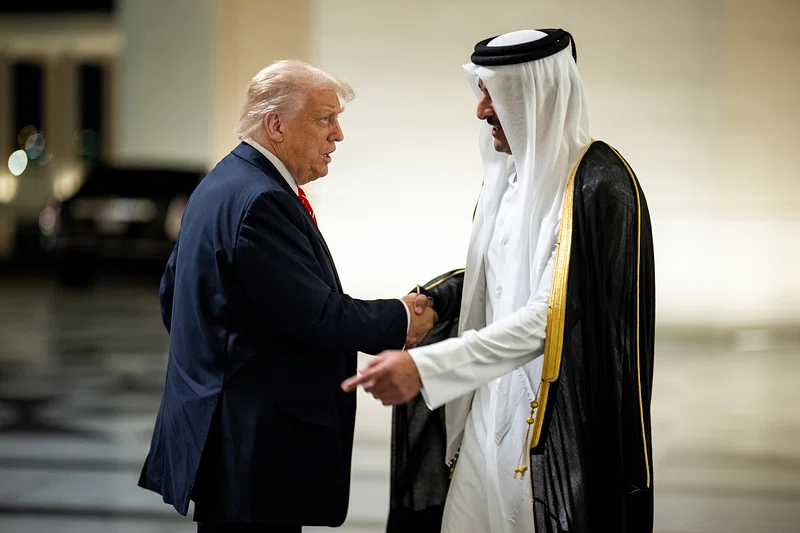
“Wealth, in Qatar’s hands, does not simply buy luxury. It buys presence”

Now that soft power has acquired a harder, shinier shell. President Donald Trump has taken his first flight aboard a retrofitted Boeing 747-800 gifted by Qatar and converted for use as an interim Air Force One. Reuters reported that the aircraft, offered by Qatar last year, was overhauled by L3Harris Technologies, flight-tested and painted in a red, white, dark blue and gold livery favoured by Trump.

Officially, the aircraft is a bridge: a stopgap while Boeing’s delayed replacement presidential jets remain years behind schedule. Reuters reported in May that the White House had accepted the luxury jet from Qatar in 2025 and asked the US Air Force to upgrade it rapidly to presidential standards. AP, meanwhile, reported that the aircraft is worth about $400m and has raised ethical and security concerns, particularly because its rapid conversion excluded some modifications planned for the final Air Force One aircraft.

That is where the story becomes more than aviation gossip. Qatar charmed the world with football; now it has charmed Washington with a flying palace. One was soft power in studs. The other is soft power in a presidential livery. In both cases, the method is similar: make yourself useful, visible and difficult to ignore.


At sea, the symbolism continues. Al Lusail, the 123-metre Lürssen superyacht associated with Qatar’s ruler, Sheikh Tamim bin Hamad Al Thani, has returned to service after a seven-month refit, according to YachtBuyer. Delivered in 2017, the yacht has a volume of 8,489GT, accommodation for up to 36 guests and quarters for 56 crew. It is less a boat than a floating embassy of taste, scale and strategic liquidity.
None of this makes Qatar merely extravagant. It makes it strategic. The country hosts US troops, mediates conflicts, finances global media and invests through a sovereign wealth fund estimated by Reuters, citing Global SWF, at about $580bn in assets under management.
This is the diplomacy of velvet and horsepower: football for the masses, aircraft for presidents, yachts for the Mediterranean gaze. Wealth, in Qatar’s hands, does not simply buy luxury. It buys presence. And, when done well, it creates global standing by stealth.

