



An IMGlobalWealth.com Lifestyle Article
Few countries embody the meeting of cultures quite like Türkiye, a nation shaped by millennia of civilisations stretching from ancient Anatolian cultures to the modern Republic founded by Mustafa Kemal Atatürk. Positioned at the crossroads of Europe, Asia and the Middle East, the country has long served as a meeting place of ideas, artistic traditions and cultural exchange.
Türkiye is a kaleidoscope of human history: rich in ancient archaeological remains, shaped by Anatolian civilisations, the Eastern Roman/Byzantine world, the Ottoman period and the modern Republic, a land where Europe meets Asia and history remains vividly alive.
The French poet and traveller Gérard de Nerval, who journeyed through the region in the nineteenth century, once described Türkiye as “a land where cultures and histories meet without losing themselves.” Contemporary Turkish novelist Elif Shafak similarly reflects on the country’s layered identity, describing it as “a mosaic of cultures, identities and memories.”

“Eser’s work invite viewers not simply to observe but to reflect, on the traces carried within cultures, communities and individuals alike”

Today, Türkiye also occupies a distinctive role in the global economic landscape. As a member of the G20 and one of the world’s larger emerging market economies, it has become an important regional investment hub attracting foreign capital across sectors ranging from manufacturing and logistics to technology and real estate.
In recent years the country has also gained visibility within the global investment migration landscape. Since 2017, Türkiye has operated a citizenship-by-investment programme allowing foreign investors to obtain Turkish citizenship through qualifying investments, including real estate acquisitions starting from US$400,000 or financial investments from US$500,000.

“A land where cultures and histories meet without losing themselves.”
Gérard de Nerval
Against this backdrop of economic dynamism, rich cultural heritage and strong modern identity, Türkiye continues to nurture a vibrant artistic environment in which questions of identity, memory and cultural inheritance remain central to contemporary creative expression.

Meeting the Artist
Within this broader cultural landscape, Turkish artist Eser Meriç Cantürk explores themes of identity, origin and collective memory through a practice that brings together painting and mosaic. IMGlobalWealth.com Editor Ray de Bono met with Cantürk to discuss the ideas, materials and cultural references that shape her work.
Born in Istanbul in 1969, Cantürk studied painting at Marmara University’s Faculty of Fine Arts between 1992 and 1996, before completing pedagogical training at Marmara University’s Atatürk Faculty of Education. She later earned a Master’s degree with a thesis examining the influence of African masks on contemporary art.
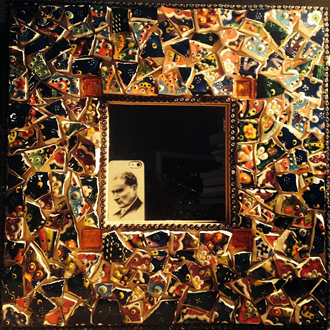
Her practice moves fluidly between painting and mosaic, using layered surfaces, natural stones, ceramics and pigments to explore the accumulation of memory over time. Cantürk continues to develop her work from her Istanbul studio, where identity, memory and cultural symbolism remain central to her artistic language.

Question 1. Your work combines painting and mosaic. How do these disciplines relate within your practice?
💬 In my artistic practice, painting and mosaic exist as two complementary fields of expression. In both disciplines, material is not merely a technical tool but a carrier of meaning.
Layers of paint, fragments of stone, ceramics and mineral surfaces function as silent witnesses extending from past to present.


Question 2. How do you approach the concept of surface in your artworks?
💬 In my paintings, the surface becomes a multilayered field of thought. Overlapping paint layers, engraved traces and repeating motifs visually reinterpret the mechanisms of memory.
Each new intervention creates an additional narrative layer, transforming the creative process into a ritualistic act.

Question 3. Natural stones and minerals often appear in your mosaic works. What role do these materials play?
💬 In my mosaic works, natural stones and semi-precious minerals such as lapis lazuli, agate, amethyst, coral, lava stone, marble and handmade ceramics carry their own histories and energies.
The breaking and reassembling of stone becomes a metaphor for fragmented memory.

Question 4. Your exhibition “Seven Faces – Seven Traces – Seven Layers” brought together several long-standing themes in your work. What was the concept behind it?
💬 In the exhibition I opened in December 2025, I brought together the concepts of identity, origin and memory within a unified narrative.
The exhibition consisted of seven large-scale works, which may appear independent at first glance yet represent different stations within the same conceptual universe.

Question 5. What ideas lie behind the title “Seven Faces – Seven Traces – Seven Layers”?
💬 “Seven Faces” refers to the multiple appearances of identity.
“Seven Traces” refers to the invisible records of the past.
“Seven Layers” refers to the overlapping structure of memory.
The layered structure in my works is not merely aesthetic but a visual reflection of how memory operates.


Question 6. What role do rituals and symbolic forms play in your artistic language?
💬 Rituals, mask culture, archaic symbols and traces of collective memory form the primary points of departure for my production.
Through materials, forms and ritual references, I aim to build bridges between individual experience and collective memory.



Conclusion
In a country where layers of history continue to shape the present, the themes explored in Cantürk’s work resonate with a broader cultural landscape. Türkiye’s rich cultural heritage, rooted in ancient Anatolian civilisations and shaped by the ideals of the modern Republic, has created an environment where questions of identity, memory and belonging remain deeply embedded in artistic expression.
Through her exploration of layered surfaces, natural materials and symbolic forms, Cantürk’s practice reflects this enduring dialogue between past and present. Her works invite viewers not simply to observe but to reflect, on the traces carried within cultures, communities and individuals alike.
In this sense, the layered structures within her paintings and mosaics mirror the cultural landscape from which they emerge: complex, interconnected and shaped by centuries of accumulated memory.


Biography
Eser Meriç Cantürk is a Turkish artist born in Istanbul in 1969. A graduate of Marmara University’s Faculty of Fine Arts, she works across painting, engraving and mosaic, exploring themes of identity, ritual and collective memory.
Eser’s practice is characterised by layered surfaces, natural stones and symbolic forms that evoke cultural continuity and the passage of time. Cantürk continues to develop her work from her studio in Istanbul.

