


An IMGloablWealth.News Report
For decades, Africa’s economic story was dominated by a familiar word: potential. In 2026, some of that long-promised wealth creation is becoming increasingly visible on balance sheets.
Africa’s 24 billionaires were worth an estimated $168.2 billion by mid-September, according to a Business Insider Africa calculation based on Forbes real-time valuations. That compares with $111.8 billion held by 26 billionaires from Saudi Arabia, the UAE, Lebanon and Qatar. The comparison is imperfect, covering only four Middle Eastern markets, but the acceleration in African fortunes is striking.

Much of the increase has come from Nigeria’s Aliko Dangote. Forbes valued him at $51.3 billion on September 16, up from $28.5 billion in March, after a private placement significantly raised the implied valuation of his giant oil refinery. The industrialist is now worth more than some established billionaire classes combined.
“Africa’s Billionaires Surge as a New Wealth Map Takes Shape”
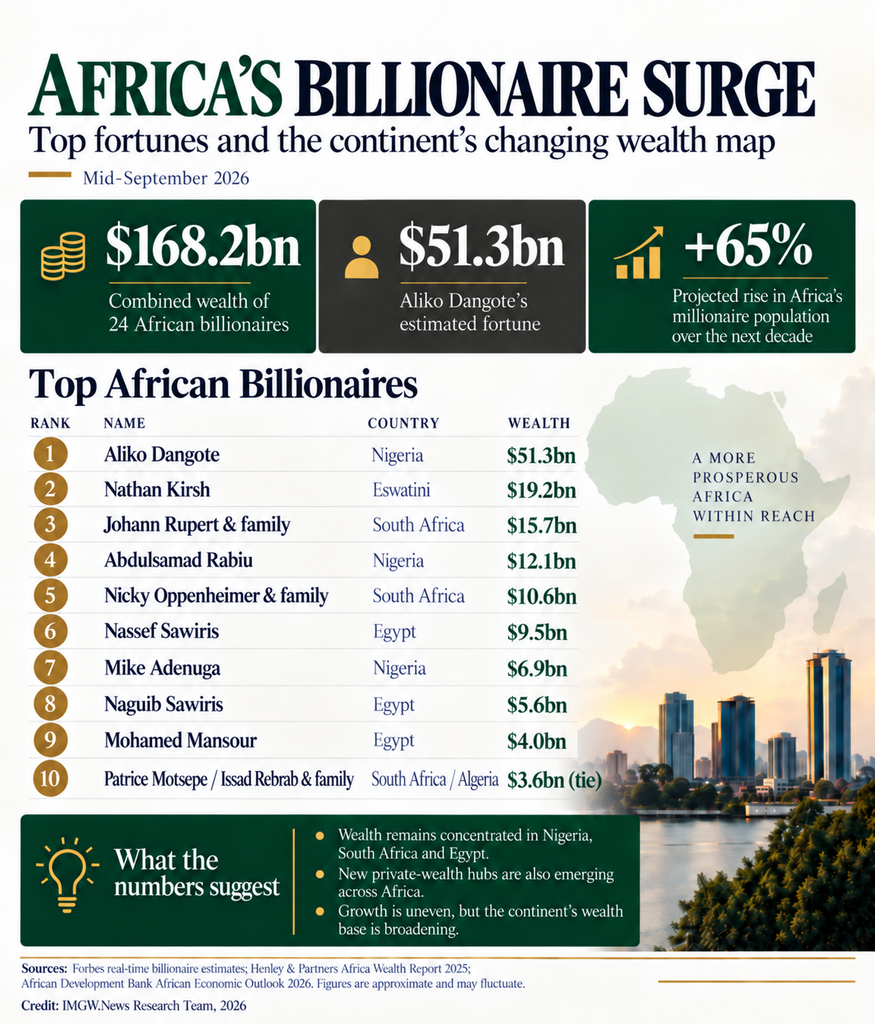
Eswatini’s Nathan Kirsh has also seen his estimated fortune rise sharply, from $9.1 billion in Forbes’ annual 2026 ranking to around $19.2 billion this month. South Africa’s Johann Rupert, Nigeria’s Abdulsamad Rabiu and the Oppenheimer family remain among the continent’s other largest fortunes.
The phenomenon is broader than a handful of billionaires. The African Development Bank expects the continent’s economy to expand by 4.2% this year, after estimated growth of 4.4% in 2025, when 22 African economies expanded by more than 5%.

Private wealth is also appearing in less traditional centres. Henley & Partners and New World Wealth counted 122,500 millionaires, 348 centi-millionaires and 25 billionaires living in Africa in their latest continental report. They project Africa’s millionaire population to increase by 65% over the coming decade. Mauritius recorded 63% millionaire growth over the previous ten years, while Rwanda rose 48% and Morocco 40%.
There are caveats. Africa’s overall millionaire population actually contracted by about 5% during the past decade, illustrating how uneven the transformation remains. Nigeria, Angola and Algeria all recorded substantial declines.
Yet the direction of travel is changing. Wealth remains concentrated in established centres such as South Africa, Egypt and Nigeria, but capital formation is spreading into financial services, technology, consumer industries, clean energy and new lifestyle and investment hubs.
Africa’s long-awaited economic awakening is still incomplete. But increasingly, it is becoming measurable.

